
Loading…
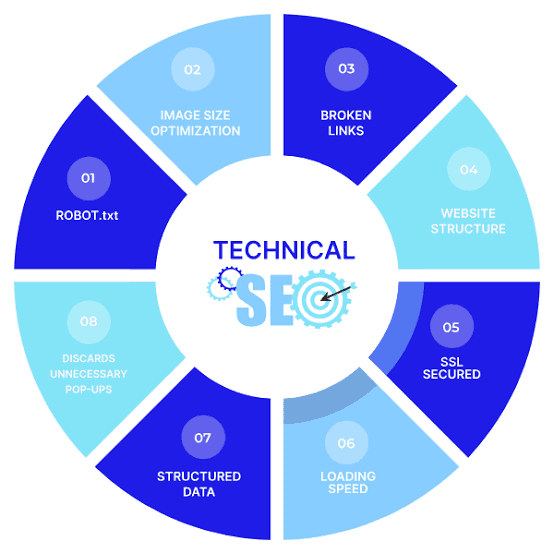
Technical SEO is invisible to visitors but decides whether search engines can find, load, and trust a page at all — crawlability, canonicalization, structured data, performance, and more.
Technical SEO is easy to overlook because it's invisible to a normal visitor — it's not the copy on the page or the keywords used in a headline. It's whether a search engine can actually find, load, understand, and trust a page in the first place. Content SEO decides what you say; technical SEO decides whether anyone — search engine or human — can reliably get to it.
Before a page can rank, a search engine has to find it (crawling) and decide to store it in its index (indexing). Broken internal links, pages accidentally blocked in robots.txt, or a `noindex` directive left on by mistake are all technical issues that can keep otherwise good content from ever being considered for ranking — no amount of good writing fixes a page a search engine never sees.
The same content is often reachable at more than one URL — with and without a trailing slash, with tracking parameters, on http vs https. Canonical tags tell a search engine which version is the "real" one, preventing duplicate versions of the same page from splitting ranking signals or confusing which URL should actually appear in results.
Structured data (schema.org markup) gives a search engine explicit, machine-readable context about a page's content — that a page is an article with a given publish date, or a product with a given price — rather than leaving the engine to infer it from surrounding text. It doesn't guarantee better rankings on its own, but it's what enables richer search result presentation and reduces ambiguity.
A sitemap is a direct list of URLs a site wants indexed, helping a search engine discover pages it might otherwise miss, especially on larger sites. `robots.txt` does the opposite job — it tells a crawler which areas of a site not to bother with, such as admin panels or account pages that have no reason to appear in search results.
How quickly a page loads and becomes usable is both a ranking factor and, more importantly, a real factor in whether visitors stay. Slow-loading pages, layout that shifts around as it loads, and slow response to the first interaction all count against a page — for the user experience first, and as an SEO signal second.
Search engines can execute JavaScript, but not as reliably or as fast as they parse plain HTML. Content that only appears after client-side JavaScript runs is at higher risk of being missed or delayed in indexing compared to content that's present in the initial server-rendered HTML — a real consideration for modern, JavaScript-heavy sites.
Search engines primarily evaluate the mobile version of a page for ranking purposes. A site that works well on desktop but is difficult to use on a phone — small tap targets, content that doesn't reflow, intrusive pop-ups — is being judged, and ranked, largely on that weaker mobile experience.
How pages link to each other tells a search engine which pages a site considers important, and helps both crawlers and real visitors find related content. A page with no internal links pointing to it is harder to discover and signals lower importance than one that's well-connected to the rest of the site.
Publishing more content on a site with unresolved technical SEO issues is like adding more rooms to a house with a cracked foundation — the new content inherits the same crawlability and indexing problems as everything else on the site.
6STANZA treats technical SEO — crawlability, canonicalization, structured data, performance — as the foundation content strategy is built on, not an optional add-on after a site is already live.